A practical technical guide for engineers, EPC contractors, procurement teams, and industrial buyers selecting valves for oil and gas applications.
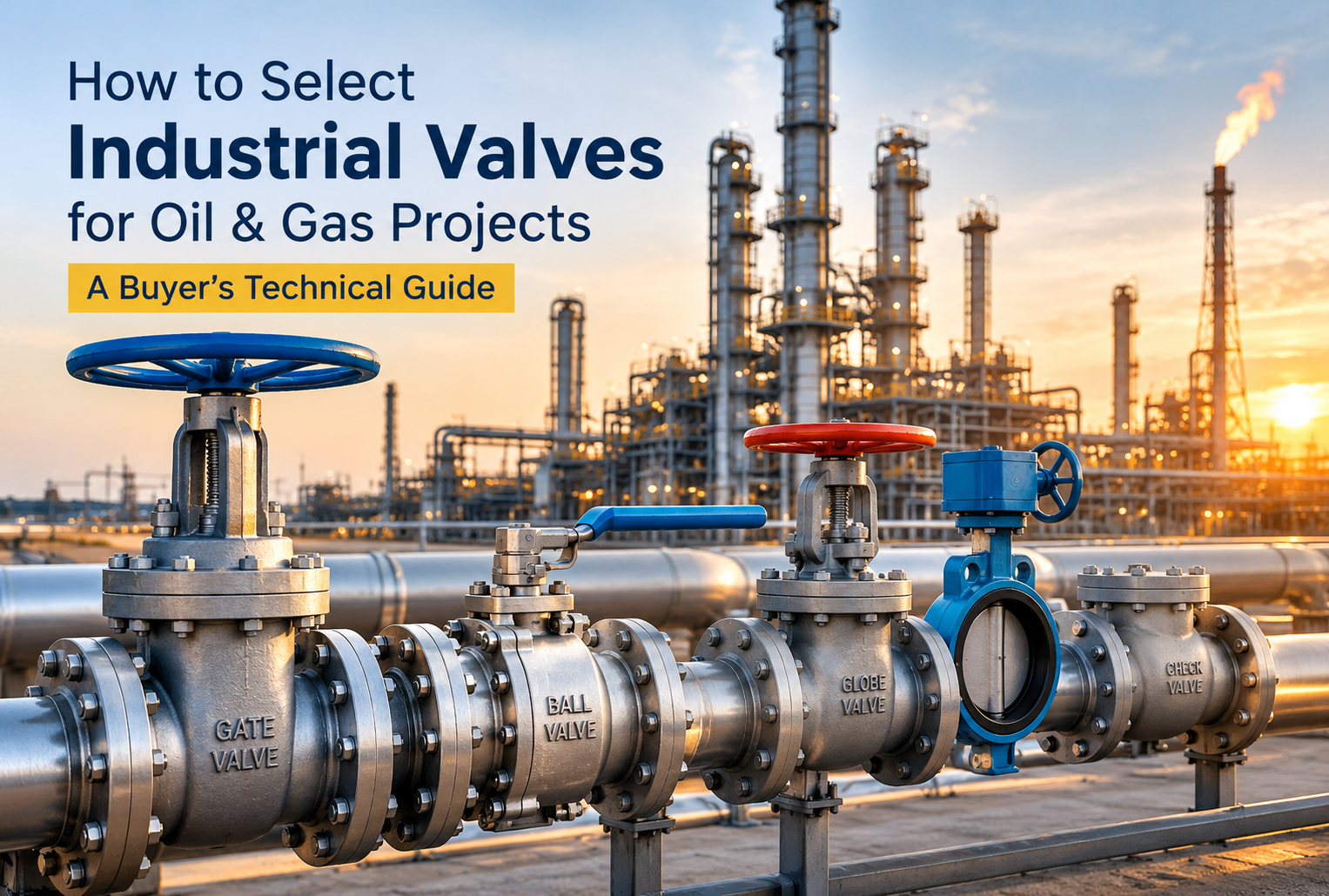
Selecting industrial valves for oil and gas projects requires evaluating operating pressure, temperature, process media, material compatibility, flow requirements, and applicable industry standards. The correct valve helps isolate equipment, regulate flow, prevent reverse flow, and meet the operating requirements of industrial piping systems.
Refineries, petrochemical plants, gas processing facilities, offshore platforms, and pipeline networks use different valve designs according to their process conditions. Buyers must evaluate each application individually because a valve suitable for one service may not be appropriate for another.
This technical guide explains the key factors engineers, EPC contractors, procurement teams, and industrial buyers should consider when selecting valves for oil and gas projects.
1. Identify the Required Valve Function
Before selecting a valve, determine whether the application requires flow isolation, throttling, automated control, or reverse-flow prevention. Different valve designs serve different purposes.
| Valve Type | Primary Function | Typical Application |
|---|---|---|
| Gate Valve | On/off isolation | Oil and gas pipelines and process lines |
| Globe Valve | Flow regulation | Process systems requiring throttling |
| Ball Valve | Quick isolation | Hydrocarbon pipelines and gas systems |
| Butterfly Valve | Isolation and suitable flow regulation | Large-diameter pipelines and utility systems |
| Check Valve | Preventing reverse flow | Pump discharge and process pipelines |
| Plug Valve | Flow isolation | Selected hydrocarbon and industrial services |
For pipeline isolation, buyers can evaluate industrial gate valves according to the required pressure rating, materials, connection type, and operating conditions.
Gate valves are generally intended for fully open or fully closed service rather than continuous throttling. Globe valves are commonly considered when flow regulation is required, while ball valves provide quarter-turn operation for suitable isolation applications.
The final choice should reflect the actual process duty and the project's technical specification.
2. Evaluate Operating Pressure and Temperature
Operating pressure and temperature directly affect valve selection, material suitability, sealing performance, and pressure containment.
Before requesting quotations, buyers should establish:
- Normal operating pressure and design pressure
- Normal operating temperature and design temperature
- Maximum and minimum expected service conditions
- Pressure class and applicable pressure-temperature ratings
- Potential pressure surges and thermal cycling
- Pressure differential across the valve
A pressure class alone does not establish suitability for every operating condition. Allowable pressure depends on the valve design, body material, temperature, and applicable standard.
For demanding process applications, the valve datasheet should specify the required design conditions so the manufacturer can evaluate an appropriate configuration.
3. Select Materials According to the Process Medium
Oil and gas facilities may handle crude oil, natural gas, refined hydrocarbons, produced water, steam, chemicals, and fluids containing corrosive contaminants.
Material selection must consider the chemical composition of the medium, operating temperature, pressure, corrosion risk, and mechanical requirements.
Common Valve Body Materials
Used in many industrial hydrocarbon and process applications when permitted by the service conditions and project specification.
Considered where specific corrosion-resistance properties are required. The appropriate grade depends on the process environment.
Used for applications requiring particular mechanical properties at specified operating temperatures or under demanding service conditions.
Used in selected utility and industrial services where their pressure, temperature, mechanical, and fluid-compatibility limitations permit their use.
Evaluate Internal Components
The valve body is only one part of the material selection process. Buyers should also review:
- Trim: Materials used for the closure element and other wetted internal components.
- Seat: Resistance to wear, erosion, temperature, and process-fluid exposure.
- Stem: Mechanical strength and compatibility with the service environment.
- Packing and gaskets: Suitability for the specified fluid, pressure, temperature, and leakage requirements.
For sour service involving hydrogen sulfide (H₂S), the project may require compliance with ISO 15156/NACE MR0175. Material suitability must be evaluated against the actual service environment and applicable project requirements.
4. Match the Valve Design to the Application
The selected valve design should provide the required flow characteristics, shut-off performance, operating method, and maintenance access.
Gate Valves for Pipeline Isolation
Gate valves are generally used for on/off isolation. When fully open, suitable designs provide a relatively unobstructed flow passage.
Forex Valves provides cast steel gate valves for industrial piping applications. Buyers should evaluate the required body material, wedge and seat configuration, pressure class, end connections, and applicable design standard before selecting a valve.
Gate valves are generally unsuitable for prolonged throttling because partial opening can cause vibration, erosion, and seat damage under inappropriate flow conditions.
Globe Valves for Flow Regulation
Globe valves use a movable disc and seat arrangement to adjust the flow passage. They are commonly used where controlled flow adjustment is required.
Industrial globe valves can be evaluated according to process pressure, temperature, fluid characteristics, required flow rate, and pressure drop.
Buyers should also consider potential cavitation, erosion, and other flow-related effects where relevant to the service.
Ball Valves for Quick Isolation
Ball valves use a rotating spherical closure element and generally operate through a quarter turn. Depending on the design, they can provide quick shut-off and a full-bore flow passage.
Selection factors include bore configuration, body and seat materials, pressure-temperature ratings, actuation requirements, and specified leakage performance.
For additional selection considerations, see the Ball Valve vs Gate Valve comparison guide .
Butterfly Valves for Large-Diameter Pipelines
Butterfly valves use a rotating disc to control flow and can be suitable for large-diameter piping systems where installation space and valve weight are important considerations.
Buyers should assess disc design, seat material, pressure rating, leakage requirements, and compatibility with the process medium. Their suitability for hydrocarbon service must be established for the specific valve design and operating conditions.
Check Valves for Reverse-Flow Prevention
Check valves allow flow in the intended direction and help prevent reverse flow. They are commonly used in pump discharge lines and other piping systems where backflow may affect connected equipment.
The selection should consider flow velocity, pressure differential, installation orientation, and the possibility of water hammer or valve slam.
Review the Forex Valves industrial product range for available valve categories, including ball, butterfly, globe, gate, and non-return valves.
5. Verify Applicable Industry Standards
Industrial valve projects may specify standards covering design, dimensions, pressure-temperature ratings, testing, and materials. Requirements vary according to valve type, application, jurisdiction, and project documentation.
This list is not a universal requirement for every valve. Buyers should confirm the relevant standard and edition, design requirements, testing procedures, inspection criteria, and supplementary project specifications.
A manufacturer's general statement about standards should not replace verification of the exact valve configuration being purchased.
6. Choose the Correct End Connection
The valve end connection must match the piping system's dimensions, pressure class, installation requirements, and applicable piping specification.
Provide bolted connections and can facilitate equipment removal for maintenance. Buyers should confirm flange dimensions, facing, rating, and gasket compatibility.
Used where permanent welded connections are specified. Welding procedures, inspection requirements, and future maintenance access should be considered.
Used in selected small-bore applications when permitted by the applicable piping class and service requirements.
Confirming end connections before procurement helps avoid dimensional incompatibility and installation delays.
7. Determine the Operating Method
Valve operation may be manual or automated, depending on valve size, operating frequency, accessibility, and process-control requirements.
Handwheels, levers, or gear operators for local operation.
Compressed-air-powered operation for suitable automated applications.
Motor-driven operation for remote control and automation.
Hydraulic power for applications requiring suitable operating force or response characteristics.
For actuated valves, buyers should confirm the required torque or thrust, operating time, power supply, control signals, environmental protection, and fail-safe position where applicable.
Emergency shutdown valves may require additional functional safety, testing, and certification provisions specified by the project.
8. Check Leakage, Fire Safety, and Environmental Requirements
Valve selection must account for the consequences of leakage and the conditions in which the equipment will operate.
Review the specified seat-leakage acceptance criteria, stem-sealing arrangement, fugitive-emissions requirements, and external environmental conditions.
For applicable hydrocarbon services, the project may specify fire-tested valve designs qualified to standards such as API 607 or API 6FA, depending on the valve type and requirements.
Fire-safe qualification should be verified for the exact valve design. It should not be assumed simply because a valve is intended for oil and gas service.
Outdoor and offshore installations may also require evaluation of humidity, salt exposure, corrosion protection, coatings, ambient temperatures, and actuator enclosure ratings.
9. Evaluate Maintenance and Total Ownership Costs
The purchase price is only one factor in the total cost of owning an industrial valve. Inspection, maintenance, spare parts, installation, replacement, and potential process downtime also affect lifecycle costs.
Before placing an order, consider:
- Accessibility for inspection and maintenance
- Availability of replacement seats, seals, stems, and other components
- Installation and removal requirements
- Expected operating frequency and service severity
- Manufacturer documentation and traceability
- Inspection and pressure-test records
- Warranty terms and technical support
The appropriate balance depends on the project's operating conditions and lifecycle requirements. A lower purchase price does not automatically mean a lower total ownership cost.
10. Industrial Valve Procurement Checklist
Use the following checklist when preparing a valve datasheet, requesting a quotation, or evaluating a manufacturer's proposal.
| Selection Parameter | Information to Confirm |
|---|---|
| Valve type | Gate, globe, ball, butterfly, check, or plug |
| Process function | Isolation, throttling, or reverse-flow prevention |
| Process medium | Fluid composition and relevant contaminants |
| Operating conditions | Design and operating pressure and temperature |
| Nominal size | Required pipe size and bore |
| Pressure class | Applicable rating for the specified service |
| Body and trim | Required materials and fluid compatibility |
| End connection | Flanged, butt-weld, socket-weld, or threaded |
| Applicable standards | Design, testing, and material requirements |
| Leakage criteria | Seat and external leakage acceptance requirements |
| Operating method | Manual, pneumatic, electric, or hydraulic |
| Special service | Sour service, fire-safe requirements, or fugitive emissions |
| Documentation | Datasheets, drawings, material certificates, and test reports as required |
The final specification should be checked against the project's piping material specification, process datasheets, line list, and engineering requirements.
Frequently Asked Questions
Which industrial valve is commonly used for oil and gas pipelines?
Gate valves and ball valves are commonly used for pipeline isolation. Check valves help prevent reverse flow, while globe valves are commonly considered for throttling. The appropriate choice depends on the process conditions and required valve function.
How do I select the correct valve pressure rating?
Evaluate design pressure, design temperature, body material, pressure-temperature ratings, and applicable standards. Confirm that the proposed valve meets the specified conditions at the intended operating temperature.
Which valve material is suitable for sour gas service?
Material suitability depends on H₂S exposure, other corrosive species, environmental conditions, mechanical requirements, and applicable sour-service specifications. The final material selection should be verified against the project requirements.
What documents should I request from a valve manufacturer?
Depending on the project specification, request approved datasheets, dimensional drawings, material test certificates, pressure-test reports, inspection records, and applicable conformity or qualification documents.
Why are valve testing and inspection important?
Testing and inspection help verify that a valve meets the specified construction, pressure-containment, leakage, and other acceptance requirements. The applicable tests and acceptance limits depend on the valve design, relevant standards, and purchase specification.
Conclusion
Selecting industrial valves for oil and gas projects requires evaluating valve function, pressure and temperature, material compatibility, design, end connections, standards, actuation, leakage requirements, and maintenance needs.
Buyers should compare each proposed valve against the actual process conditions and project documentation rather than selecting equipment based on size, price, or valve category alone. A complete technical specification helps the procurement team assess suitability and verify compliance before approving the purchase.
Forex Valves offers a range of industrial valve products for different process and piping applications. Buyers can review the industrial valve product range to identify relevant product categories and compare available configurations against their project requirements.
Explore the Forex Valves industrial valve product range for different process and piping applications.