
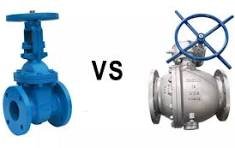
Ball valves and gate valves are common types of valves used to control and isolate the flow of liquids and gases in industrial piping systems. Both are primarily used for on/off service, but they differ in construction, operating mechanism, opening and closing speed, flow characteristics, sealing, automation and application suitability.
The main difference is the way the closure element operates. A ball valve uses a rotating ball and typically requires a 90-degree quarter turn to open or close. A gate valve uses a gate or wedge that moves up and down and generally requires multiple turns of the handwheel or stem.
Proper valve selection depends on media, pressure, temperature, pipe size, flow conditions, operating frequency, shut-off requirements, valve materials, actuation and installation requirements.
A ball valve is an isolation valve that uses a spherical closure element with a central bore to control fluid flow. When the bore is aligned with the pipeline, fluid can pass through the valve. Rotating the ball 90 degrees moves the bore perpendicular to the flow path, placing the solid section of the ball across the passage and stopping flow.
Ball valves are widely used where quick operation and tight shut-off are required. Their quarter-turn design also makes them suitable for manual operation as well as pneumatic and electric actuation.
A ball valve works by rotating the ball on its axis. In the fully open position, the ball bore is aligned with the pipeline, providing a relatively direct flow path. When the handle or actuator turns the ball 90 degrees, the bore rotates away from the flow path and the valve closes.
This quarter-turn operation allows a ball valve to open and close faster than multi-turn valve designs.
Ball valves are available in different configurations to meet various pressure ratings, sizes and service conditions. Two common industrial designs are:
The appropriate ball valve configuration depends on valve size, pressure class, operating conditions, media and project requirements.
Ball valves are commonly used for isolation in:
A full-bore ball valve provides a relatively unobstructed flow path when fully open, which can help reduce flow restriction.
A gate valve is an isolation valve that uses a gate or wedge to open or close a flow passage. When fully open, the gate moves out of the flow path and provides a relatively straight-through passage. When fully closed, the gate blocks the flow.
Gate valves are generally designed for full-open or full-closed isolation rather than continuous flow regulation.
The stem of a gate valve is operated by a handwheel or actuator. Depending on the valve design, the stem raises or lowers the gate or wedge to open or close the flow passage.
Gate valves generally require several turns to move from fully open to fully closed because the gate moves through the valve body rather than rotating through a quarter turn.
This operating characteristic makes gate valves suitable for applications where valves are operated occasionally for pipeline or equipment isolation.
Gate valves are commonly used in:
A fully open gate valve provides a relatively unobstructed flow path and can be suitable where low flow resistance is important.
| Feature | Ball Valve | Gate Valve |
|---|---|---|
| Closure element | Rotating ball | Moving gate or wedge |
| Movement type | Quarter-turn | Multi-turn |
| Normal operation | Approximately 90° | Several turns of handwheel or stem |
| Opening and closing speed | Fast | Slower |
| Main function | Isolation and rapid shut-off | Full-open/full-closed isolation |
| Fully open flow path | Low restriction, depending on bore | Low restriction |
| Frequent operation | Generally suitable | Generally less suitable |
| Automation | Quarter-turn actuators | Multi-turn actuation |
| Throttling | Not recommended for typical designs | Not recommended for typical designs |
| Typical applications | Oil & gas, chemical, petrochemical and process systems | Water, pipelines, power and industrial isolation |
Neither valve type is better in every application. The appropriate choice depends on operating conditions and the function required from the valve.
The operating mechanism is one of the most important differences between the two valve types. A ball valve rotates its spherical closure element, while a gate valve moves its gate or wedge in a straight line.
The spherical closure element in a ball valve rotates around its axis. When the bore is aligned with the pipeline, fluid can flow through the valve. When the ball is rotated 90 degrees, the bore moves out of the flow path and the solid section blocks the passage.
The short rotational movement makes ball valves suitable for applications requiring fast isolation and quarter-turn automation.
A gate valve uses a gate or wedge that moves in a straight line into or out of the flow path. The stem transfers movement from the handwheel or actuator to the gate.
When the gate is fully raised, the flow passage is open. Lowering the gate into the closed position blocks the flow.
Ball valves can generally be opened or closed quickly because they require only a 90-degree turn.
Gate valves require several turns to move the gate between fully open and fully closed positions. They therefore operate more slowly but are suitable for pipelines and equipment where valves are not operated frequently.
Both valve types can provide low flow resistance when fully open, but actual pressure drop depends on valve design, size, bore, flow rate, fluid properties and operating conditions.
A full-bore ball valve may have an internal bore that closely matches the pipe diameter, providing a relatively unobstructed flow path. A fully open gate valve also provides a relatively straight flow path with little obstruction.
Proper pressure-drop evaluation should consider manufacturer flow data and the actual operating conditions rather than relying only on the general characteristics of the valve type.
Ball valves are commonly selected when rapid and tight shut-off is required. The spherical ball works with the valve seats to close the flow passage.
Gate valve sealing performance depends on factors including gate design, seat arrangement, materials, pressure, temperature and process media.
For severe service involving high pressure, high temperature, corrosive media or hazardous fluids, valve selection should consider the required pressure-temperature rating, body material, seat material and applicable design and testing standards.
Ball valves are well suited to pneumatic and electric quarter-turn actuators because they require approximately 90 degrees of movement.
Gate valves require actuation systems capable of multi-turn movement. Actuator selection depends on valve size, operating pressure, operation frequency, available power and project requirements.
Standard ball and gate valves are primarily isolation valves rather than general-purpose control valves.
Gate valves are generally not recommended for continuous throttling. When partially open, high-velocity flow can act on the gate and seats, increasing the potential for erosion, vibration and wear.
Conventional ball valves are also normally operated fully open or fully closed. Specialised designs such as V-port ball valves can provide flow-modulation capability for suitable applications.
Ball valves are often selected when quick operation, reliable isolation and actuator compatibility are important.
Ball valves are used in oil and gas facilities to isolate process lines, pipelines, storage systems and equipment. Depending on the design and service conditions, trunnion mounted ball valves can be used for higher-pressure applications when appropriately rated.
Ball valves are used in refineries and petrochemical plants to isolate hydrocarbons and other process media where rapid operation and tight isolation are required.
Chemical process systems handle liquids and gases with different pressure, temperature and corrosion characteristics. Ball valve body and seat materials can be selected according to the media and operating conditions.
Ball valves are used in process piping and equipment isolation applications where quarter-turn operation and actuator compatibility provide operational benefits.
Gate valves are generally used for pipeline and equipment isolation, with the valve fully open during normal operation or closed when isolation is required.
Gate valves are widely used in water pipelines, distribution networks and utility systems. When fully open, they provide a relatively unobstructed flow path and are suitable for many water pipeline applications.
Gate valves can be used for pipeline isolation when their pressure class, materials, design and applicable standards are appropriate for the service.
Gate valves are used in power-generation facilities in water, steam and process piping systems. Valve materials and construction must be compatible with the operating pressure, temperature and fluid conditions.
Gate valves are often installed at equipment and pipeline isolation points in manufacturing and process plants where frequent operation is not required.
The proper valve should be selected according to the service requirements rather than choosing one valve type over another.
Before selecting a ball valve or gate valve, consider:
Selection of valves for industrial projects in Ahmedabad, India and international markets should be based on actual service conditions and project specifications.
Forex Valves supplies industrial ball valves and gate valves for isolation applications. The company's ball valve range includes floating ball valves and trunnion mounted ball valves.
Its wider industrial valve portfolio includes gate, globe, butterfly, check, diaphragm and plug valves.
The company's industrial valve range serves applications in oil and gas, chemical processing, petrochemical, power generation, marine, pharmaceutical and water treatment industries.
For industrial projects, valve design, pressure rating, materials, connection type, actuation and applicable standards should match the actual operating conditions.
For more information about industrial gate valves, see gate valves from Forex Valves.
Neither valve is best in all applications. Ball valves are generally preferred where fast isolation, frequent operation and quarter-turn actuation are required. Gate valves are generally used for full-open or full-closed pipeline isolation where low flow resistance is important.
A ball valve uses a spherical closure element that rotates and is usually operated through a 90-degree quarter turn. A gate valve uses a movable gate or wedge and generally requires several turns to open or close.
Ball valves are typically well suited to frequent operation because their quarter-turn mechanism allows rapid opening and closing.
Standard gate valves are generally not intended for continuous throttling. Partial opening can expose the gate and seats to high-velocity flow, increasing the potential for erosion, vibration and wear.
Depending on design, both full-bore ball valves and fully open gate valves can offer low resistance to flow. Actual pressure drop depends on valve design, bore, size, flow rate, fluid properties and operating conditions.
Yes. Ball valves are widely used for isolation in oil and gas systems, provided that the valve design, materials, pressure rating, temperature rating and applicable standards meet the service requirements.