
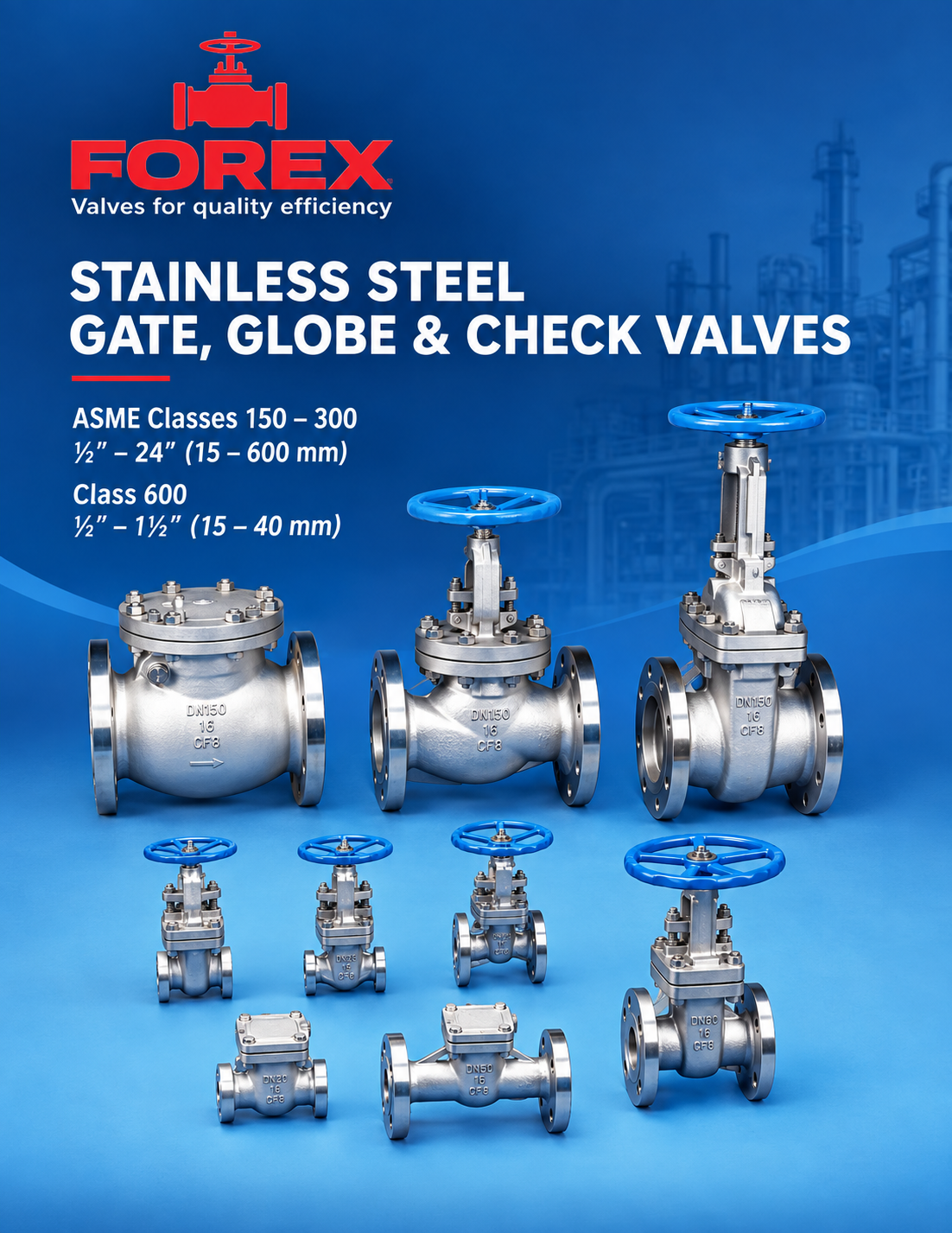
Stainless Steel Valves
Stainless steel valves are industrial flow-control components used to isolate, regulate, and direct the flow of liquids and gases in piping systems. Their suitability depends on the valve design, stainless steel grade, process medium, operating pressure, temperature, and sealing materials.
Forex Valves offers industrial valve solutions for different flow-control requirements. Selecting a suitable stainless steel valve involves evaluating material compatibility, operating conditions, connection requirements, and the intended function of the valve.
Types of Stainless Steel Valves
Stainless Steel Ball Valves
Stainless steel ball valves use a rotating ball with a bore to open or close the flow passage. They are commonly used for on-off flow control where the valve design meets the application's pressure, temperature, and sealing requirements.
Explore our range of ball valves for industrial flow-control applications.
Stainless Steel Gate Valves
Gate valves use a movable gate to isolate flow through a pipeline. They are generally selected for fully open or fully closed service rather than routine throttling. Selection depends on the process medium, pressure and temperature requirements, and valve construction.
Stainless Steel Globe Valves
Globe valves use a movable disc or plug that works against a seat to control fluid flow. They can be considered for applications requiring flow adjustment, subject to the valve's design and allowable pressure drop.
Explore our industrial globe valves for related product information.
Stainless Steel Butterfly Valves
Butterfly valves use a rotating disc to control flow through a pipeline. Their compact design can be useful where installation space and weight are important considerations. The body, disc, seat, and other wetted materials must be compatible with the operating conditions.
Stainless Steel Check Valves
Check valves permit flow in the intended direction and help prevent reverse flow. The suitable design depends on the installation arrangement, process conditions, and required flow characteristics.
Stainless Steel Plug Valves
Plug valves use a rotating plug with a flow passage to open, close, or redirect flow, depending on the configuration. Plug design, sealing arrangement, operating torque, and material compatibility should be evaluated for the intended service.
View our plug valves for related product information.
Stainless Steel Grades and Material Selection
Stainless steel grades differ in chemical composition, mechanical properties, and corrosion resistance. Grades such as 304 and 316 may be suitable for particular applications, but the correct grade depends on the fluid composition, concentration, temperature, and exposure conditions.
Commonly used in general corrosion-resistance applications. Suitability depends on the process medium and operating conditions.
Contains molybdenum, which can improve resistance to certain forms of corrosion, including some chloride-containing environments.
Applications of Stainless Steel Valves
Stainless steel valves may be used in industrial systems where the selected grade and valve construction meet the application requirements, including:
Key Considerations When Selecting Stainless Steel Valves
Choosing a suitable valve requires evaluating the following factors:
- Process medium: Identify the liquid or gas and assess its compatibility with the valve materials.
- Operating pressure and temperature: Confirm the valve's allowable operating conditions using manufacturer documentation.
- Valve function: Determine whether the application requires isolation, flow regulation, or reverse-flow prevention.
- Material grade: Specify the required stainless steel grade and relevant component materials.
- Sealing materials: Check seat, gasket, and packing compatibility with the process medium and temperature.
- Size and end connections: Match the valve dimensions and connection type to the piping system.
- Standards and testing: Confirm the applicable design, inspection, and testing requirements.
Stainless Steel Valves from Forex Valves
Forex Valves is based in Ahmedabad, Gujarat, India, and serves industrial valve requirements. When enquiring about stainless steel valves, specify the required valve type, material grade, nominal size, pressure rating, end connection, operating temperature, and process medium.
Contact Forex Valves to confirm product availability and obtain specifications for your application.
Frequently Asked Questions
What are stainless steel valves used for?
Stainless steel valves are used to isolate, regulate, or direct fluid flow in industrial piping systems. Their applications depend on the valve design, material grade, and operating conditions.
Which stainless steel grades are used in industrial valves?
Grades such as 304 and 316 are used in suitable applications. The correct grade depends on corrosion requirements, process-fluid compatibility, temperature, and the applicable specification.
Are stainless steel valves suitable for corrosive fluids?
They may be suitable for certain corrosive fluids, depending on the stainless steel grade, fluid composition, temperature, and sealing materials. Compatibility should be verified before selection.
How do I select the right stainless steel valve?
Consider the required valve function, process medium, pressure, temperature, material grade, sealing components, valve size, end connections, and applicable standards.
Are all valve types available in stainless steel from Forex Valves?
Availability depends on the specific valve model and material specification. Contact Forex Valves to confirm the required configuration and grade.