
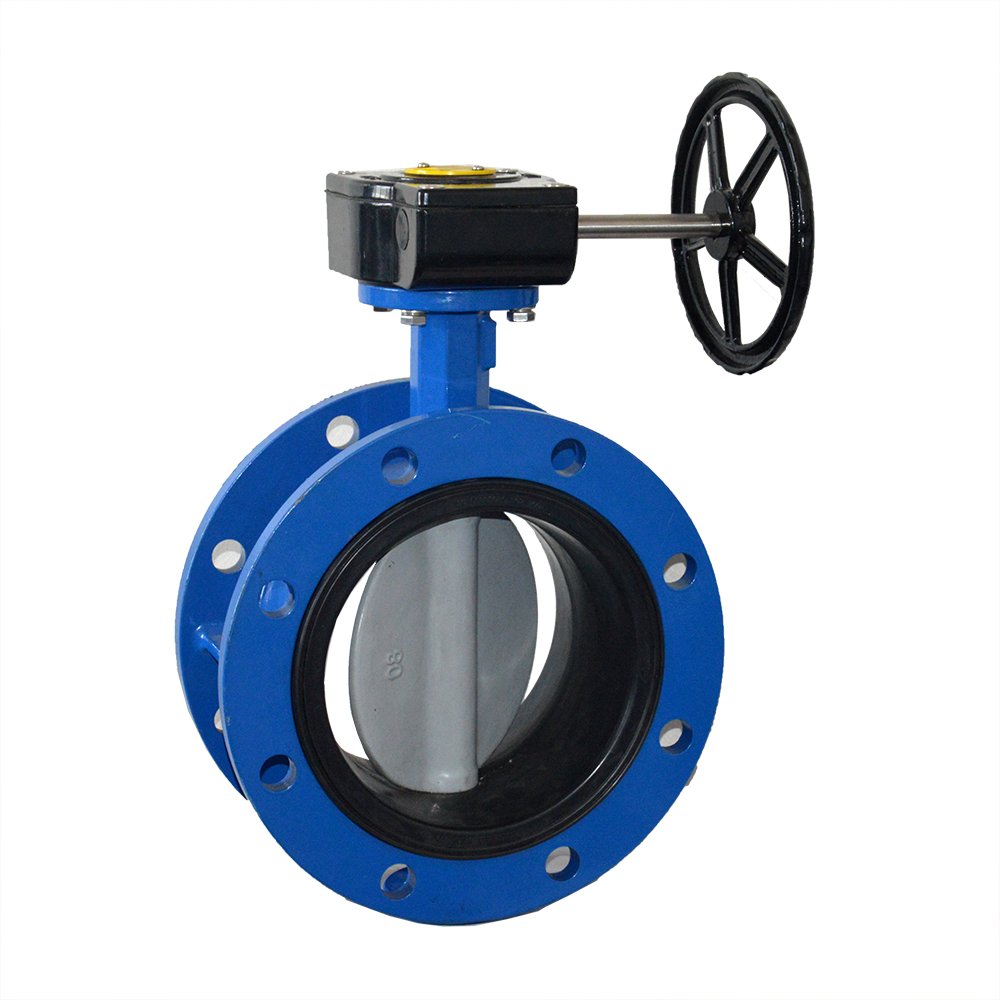
A butterfly valve is a quarter-turn flow control valve that uses a rotating disc to start, stop, isolate, and regulate fluid flow through a pipeline. The disc is mounted on a rotating shaft and turns through approximately 90° between the open and closed positions.
What Is a Butterfly Valve?
A butterfly valve controls fluid flow by rotating a disc inside the valve body. Its quarter-turn operating mechanism allows the disc to move between open, partially open, and closed positions.
Butterfly valves are used in water treatment, HVAC systems, chemical processing, oil and gas, power generation, fire protection, and industrial piping. Their compact construction and quarter-turn operation make them suitable for many large-diameter piping systems.
How Does a Butterfly Valve Work?
The main operating component is a circular disc connected to a rotating shaft. Turning the shaft changes the position of the disc and controls the passage available for fluid flow.
Fully Open
The disc rotates approximately 90° from the closed position and moves largely parallel to the flow path, allowing fluid to pass through the valve.
Partially Open
The disc remains at an intermediate angle and restricts the flow passage. This position can be used for flow regulation when the valve design is suitable for throttling.
Fully Closed
The disc rotates across the pipeline and seals against the seat, blocking the flow through the valve.
The disc is operated through a shaft connected to a lever, gearbox, pneumatic actuator, or electric actuator, depending on the valve size, application, and automation requirements.
Types of Butterfly Valves
Butterfly valves can be classified by their body and connection design, disc and shaft arrangement, and sealing geometry.
1. Wafer Type Butterfly Valve
A wafer butterfly valve is installed between two pipe flanges. Its compact body is suitable where installation space and valve weight are important considerations.
Wafer butterfly valves are commonly used in water distribution, cooling and heating systems, and general industrial piping.
2. Lug Type Butterfly Valve
A lug type butterfly valve is installed between flanges and has threaded lugs or inserts in the valve body. The lug design allows sections of piping to be isolated for servicing.
3. Flanged Butterfly Valve
A flanged butterfly valve has integral flanges that connect directly to the flanges of the pipeline. This design is selected where a flanged connection is required and is available in different pressure classes and materials.
4. Double Offset Butterfly Valve
In a double offset butterfly valve, the shaft is positioned away from the disc centerline and sealing axis. This offset reduces contact between the disc and seat during opening and closing, which can reduce seat wear and improve sealing performance.
5. Triple Offset Butterfly Valve
A triple offset butterfly valve uses three geometric offsets to create a cam-like disc movement. The design minimizes rubbing between the sealing surfaces during operation and is used in demanding applications, including services where higher-temperature operation is required.
Butterfly Valve Materials
Material selection depends on the fluid, operating temperature, pressure, corrosion conditions, and application.
Common butterfly valve body materials include:
- Cast Iron (CI)
- Ductile Iron (DI)
- Carbon Steel
- Stainless Steel
- Cast Steel
- Aluminium for selected applications
Common seat materials include EPDM, NBR, PTFE, and metal. The appropriate seat material depends on the service conditions and media.
Applications of Butterfly Valves
Butterfly valves are used across fluid handling and process piping systems, including:
- Water and wastewater treatment
- HVAC and chilled-water systems
- Fire protection systems
- Chemical processing
- Oil and gas systems
- Power plants
- Food and beverage processing
- Industrial cooling systems
- General process piping
The valve type, body material, disc material, seat material, pressure rating, and actuator should be selected according to the operating conditions of the piping system.
Advantages of Butterfly Valves
- Compact and lightweight construction
- Quarter-turn operation for quick opening and closing
- Suitable for large-diameter pipelines
- Available in manual and automated configurations
- Available with different body, disc, shaft, and seat materials
- Can be used for isolation and, with suitable design, flow control
- Requires comparatively less installation space than many larger valve designs
Butterfly Valve vs Gate Valve
Both butterfly valves and gate valves can be used for pipeline isolation, but they use different operating mechanisms and have different installation characteristics.
| Feature | Butterfly Valve | Gate Valve |
|---|---|---|
| Operating movement | Quarter-turn | Multi-turn |
| Main component | Rotating disc | Rising or non-rising gate |
| Installation space | Compact | Generally requires more space |
| Operation speed | Fast | Slower |
| Large pipeline applications | Common | Common |
| Typical use | Isolation and flow control | Primarily isolation |
The appropriate valve depends on pressure, temperature, fluid type, pipe size, required flow control, installation space, and operating frequency.
How to Choose a Butterfly Valve
Consider the following factors when selecting a butterfly valve for a piping system.
- Pipe Size: Select the valve nominal size according to the pipeline size.
- Pressure Rating: Check that the valve pressure rating is suitable for the system operating pressure.
- Temperature: Verify that the body and seat materials are suitable for the operating temperature.
- Fluid Type: Consider the medium, such as water, air, chemicals, steam, hydrocarbons, or other process fluids.
- Body and Disc Material: Select materials according to corrosion conditions and operating requirements.
- Seat Material: Choose an elastomeric or metal seat according to the application and service conditions.
- End Connection: Select wafer, lug, or flanged construction according to the piping arrangement.
- Operation: Select a lever, gearbox, pneumatic actuator, or electric actuator based on valve size and automation requirements.
Frequently Asked Questions About Butterfly Valves
What is the main function of a butterfly valve?
A butterfly valve controls or isolates fluid flow by rotating a disc around an axis inside the valve body.
What are the main types of butterfly valves?
Common types include wafer, lug, flanged, double offset, and triple offset butterfly valves.
Are butterfly valves suitable for large pipelines?
Yes. Butterfly valves are commonly used in large-diameter pipelines because their compact construction can reduce space and weight requirements compared with some other valve designs.
What is the difference between wafer and lug butterfly valves?
A wafer butterfly valve is fitted between two pipe flanges, while a lug butterfly valve has threaded lugs or inserts that provide mounting points for the valve.
Can butterfly valves be automated?
Yes. Butterfly valves can be operated automatically using pneumatic or electric actuators for opening, closing, and suitable flow-control applications.
Butterfly Valve Selection
Selecting the correct butterfly valve requires consideration of pipe size, pressure, temperature, fluid type, materials, seat design, end connection, and operating method.