
Selecting the right pneumatic actuator for an industrial valve requires more than matching the actuator to the valve size. The selection process should consider valve operating torque or thrust, available air pressure, operating conditions, control requirements, mounting compatibility and the required operating cycle.
An appropriately sized actuator helps provide reliable valve operation, consistent control and suitable performance under the specified operating conditions. This guide explains the main factors to consider when selecting a pneumatic actuator for industrial valve applications.
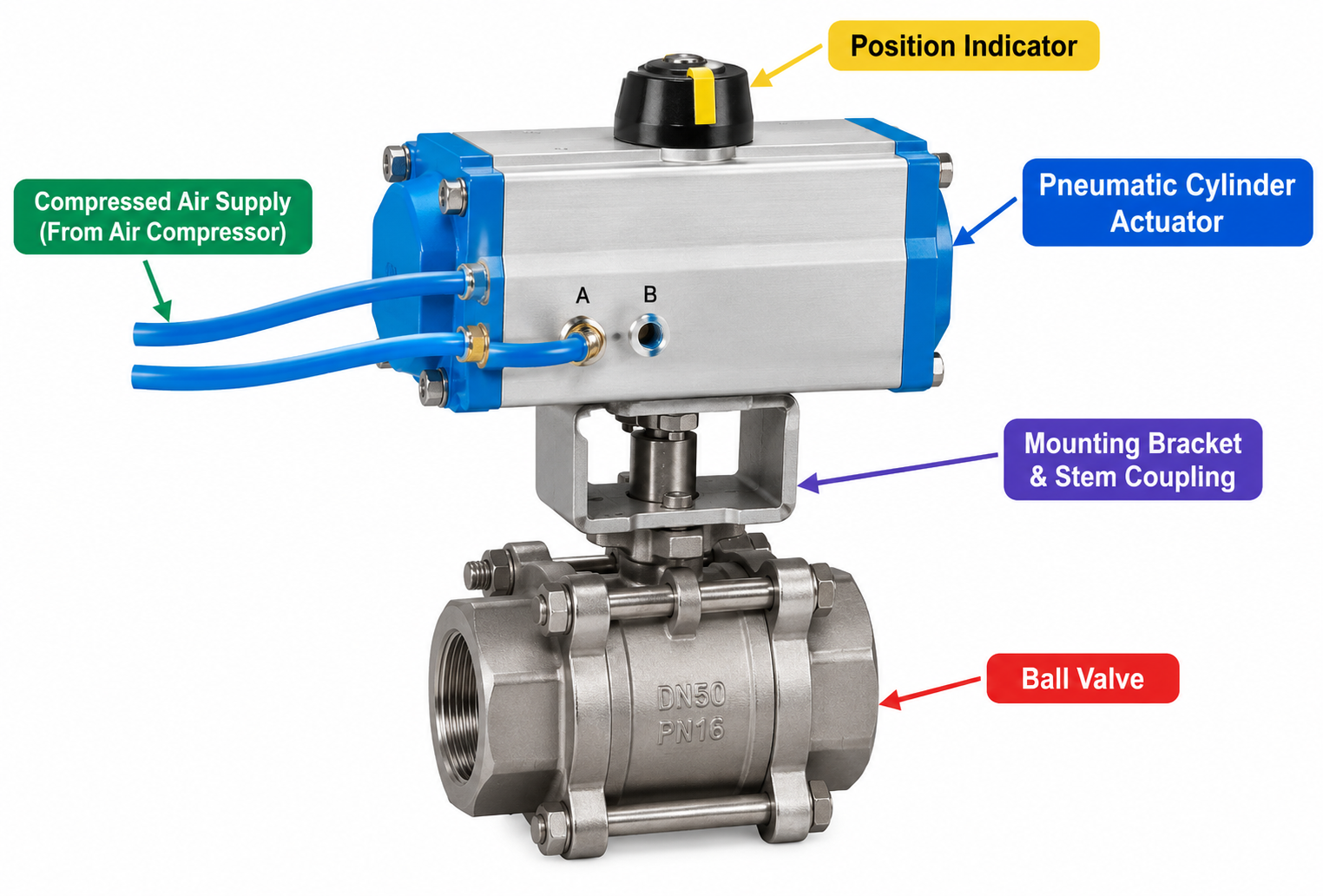
What Is a Pneumatic Valve Actuator?
A pneumatic valve actuator is a device that uses compressed air to operate a valve. Depending on the actuator design, it converts air pressure into rotary or linear motion.
Pneumatic actuators are commonly used in industrial automation where valves must be operated remotely, integrated with control systems or opened and closed as part of a process.
Rotary pneumatic actuators are commonly used with quarter-turn valves, including butterfly valves and ball valves. Linear actuators are used for valves that require linear stem movement, depending on the valve design and actuator configuration.
A typical automated valve assembly may include:
- A valve body and its operating mechanism
- A compatible pneumatic actuator
- A compressed-air supply
- A solenoid valve or other control device
- Position indicators or limit switches, where required
- A positioner for applications requiring modulating control
The required components depend on the application and the intended level of automation.
1. Identify the Valve Type and Required Movement
The valve type is one of the first factors to consider because different valves have different operating mechanisms and motion requirements.
Ball Valves
Ball valves generally use quarter-turn rotary movement. The actuator must provide sufficient torque to operate the valve throughout the required operating conditions.
Butterfly Valves
Butterfly valves also use quarter-turn rotary movement. Actuator selection should account for the valve's operating torque, pressure conditions, seat or disc design and service requirements.
For automated applications, pneumatic butterfly valves combine a butterfly valve with pneumatic actuation to support remote or automated operation.
Gate Valves
Gate valves typically use linear stem movement and may require multiple turns of the handwheel or stem to travel between positions. Their automation requirements differ from those of quarter-turn valves. A suitable actuator must match the valve's operating mechanism and required thrust or torque.
Explore industrial gate valves when evaluating valve types for an application.
Globe Valves
Globe valves use a movable disc or plug to regulate flow through the valve seat. Depending on the design and application, they may require linear actuation and specific thrust or control characteristics.
Review industrial globe valves when assessing valve options that require flow regulation.
Important: Do not select an actuator based on nominal valve size alone. The valve manufacturer's operating torque or thrust data should be the starting point for actuator sizing.
2. Determine the Required Torque or Thrust
Torque and thrust are key parameters in actuator selection.
- Torque is the rotational force required to operate a rotary valve.
- Thrust is the linear force required to move a valve stem or other linear mechanism.
For rotary valves, required torque can vary with valve design, differential pressure, seat material, process conditions, operating frequency and the condition of the valve.
For linear valves, required thrust depends on the valve mechanism, pressure forces, packing friction and other operating factors.
Obtain the valve manufacturer's torque or thrust requirements for the relevant operating conditions. The actuator's available output must meet those requirements across the complete operating movement, including any applicable safety margin specified by the valve or actuator manufacturer.
An undersized actuator may fail to operate the valve reliably. An oversized actuator may add unnecessary cost and can create mechanical or operational issues if the assembly is not properly matched.
3. Choose Between Double-Acting and Spring-Return Actuators
Pneumatic actuators are available in different configurations. Two common options are double-acting and spring-return designs.
| Feature | Double-Acting Actuator | Spring-Return Actuator |
|---|---|---|
| Operating force | Compressed air drives movement in both directions. | Air drives movement against a spring; the spring provides return movement. |
| Air requirement | Air is required to drive both operating directions. | Air is used to move the actuator against the spring. |
| Loss of air supply | The final position depends on the actuator, valve and system arrangement. | The spring moves the actuator toward its designed return position. |
| Selection consideration | Applications requiring powered movement in both directions. | Applications requiring a designed return position. |
A spring-return actuator can be configured to fail open or fail closed, depending on the actuator and valve arrangement. The required fail position must be determined from the process safety requirements.
Safety consideration: Do not assume that loss of air automatically places every automated valve in a safe position. The complete assembly, including the actuator, solenoid valve, air circuit and any stored energy, must be assessed.
4. Check the Available Air Supply Pressure
The available compressed-air pressure directly affects actuator output. Before selecting an actuator, confirm the minimum and maximum air pressure available at the actuator inlet under operating conditions.
Consider the following:
- Minimum available supply pressure
- Pressure losses through tubing, fittings and control components
- Air consumption and supply capacity
- The actuator manufacturer's output data at the applicable pressure
- The pressure rating and compatibility of the pneumatic components
An actuator must provide the required torque or thrust at the minimum specified operating pressure, not merely at the nominal pressure of the plant's air system.
If the air pressure falls below the level required for reliable operation, the actuator may not complete its movement or operate the valve as intended.
5. Size the Actuator for the Actual Application
Correct sizing requires matching the actuator's output to the valve's operating requirements throughout the required movement.
A practical sizing process includes:
- Identify the valve type, model and operating mechanism.
- Obtain the manufacturer's torque or thrust requirements.
- Confirm the operating pressure and process conditions.
- Determine the minimum available pneumatic supply pressure.
- Compare the required output with the actuator manufacturer's output tables.
- Apply the manufacturer's sizing guidance and the appropriate engineering margin.
- Check compatibility with the mounting arrangement and valve stem or shaft.
- Confirm the suitability of the complete assembly under normal and abnormal operating conditions.
For spring-return actuators, check the available output at the relevant points of the operating stroke. Spring force changes throughout the stroke, so the output must be suitable for both the required movement and the intended return function.
For double-acting actuators, check the output in both directions using the manufacturer's specified operating data.
6. Select the Required Control Function
The actuator must also match how the valve will be operated.
On/Off Control
On/off applications move a valve between its designated open and closed positions. Depending on the system, a solenoid valve may direct compressed air to the actuator.
Position indicators or limit switches can be used where confirmation of the valve position is required.
Modulating Control
Modulating applications require the valve to move to intermediate positions to regulate flow or another process variable. These applications may require a compatible positioner, control signal, feedback arrangement and a valve-actuator combination designed for the required control performance.
Not every on/off actuator assembly is suitable for accurate modulating service. Confirm the manufacturer's compatibility and performance specifications before selecting the equipment.
7. Consider the Operating Environment
The installation environment can affect actuator reliability and service life. Review the conditions where the equipment will be installed.
- Ambient temperature and temperature variation
- Indoor or outdoor installation
- Moisture, dust and corrosive exposure
- Required ingress protection
- Hazardous-area requirements, where applicable
- Compatibility of seals, coatings and construction materials
- Applicable industry and site requirements
The actuator, accessories and electrical components should be suitable for the actual operating environment. Verify protection ratings, temperature limits and any hazardous-area certifications against the project requirements.
8. Check Mounting and Mechanical Compatibility
Before purchasing an actuator, verify that it can be mounted correctly on the selected valve.
Check the mounting interface, shaft or stem dimensions, coupling, bracket, available clearance and direction of movement. The actuator must not interfere with adjacent pipes, equipment or maintenance access.
For rotary valves, confirm the actuator's rotation angle and the compatibility of its output shaft or drive interface with the valve. For linear valves, check the stem connection, travel and required thrust.
A mechanically incompatible actuator may require additional mounting components or modifications. Confirm these requirements before finalizing the selection.
9. Evaluate Operating Speed and Cycle Requirements
The required operating speed depends on the process, valve design and control system.
Fast valve movement may be appropriate for some applications, but it can also create pressure surges or water hammer in piping systems. The acceptable operating time should therefore be determined from the process requirements and a suitable engineering assessment.
Also consider the number of operating cycles, duty requirements, expected service life and maintenance access. Confirm that the actuator and its accessories are rated for the intended operating frequency.
10. Select the Necessary Accessories
Accessories should be selected according to the control strategy, monitoring requirements and operating environment.
| Accessory | Purpose |
|---|---|
| Solenoid valve | Directs pneumatic air to control actuator movement. |
| Limit switch box | Provides open/closed or other configured position signals. |
| Position indicator | Provides a visual indication of valve position. |
| Positioner | Controls actuator position in response to a compatible control signal. |
| Air filter-regulator | Helps condition and regulate the air supply where specified. |
| Pneumatic tubing and fittings | Connect the air supply and control components. |
| Manual override | Allows manual operation where supported and appropriate. |
Not every installation requires every accessory. Confirm the necessary configuration with the control-system design, actuator manufacturer and project specifications.
Common Mistakes When Selecting a Pneumatic Actuator
Avoid these common selection errors:
- Choosing an actuator based only on valve size.
- Ignoring the valve manufacturer's torque or thrust requirements.
- Using nominal air pressure instead of the minimum available operating pressure.
- Failing to check the actuator output throughout the required stroke.
- Selecting double-acting or spring-return operation without defining the required response to loss of air.
- Overlooking mounting dimensions and mechanical compatibility.
- Using an on/off configuration where modulating control is required.
- Ignoring temperature, moisture, corrosion or hazardous-area requirements.
- Selecting accessories without checking their compatibility with the actuator and control system.
A complete review of the valve, actuator, air supply, accessories and operating conditions helps reduce these risks.
Pneumatic Actuator Purchasing Checklist
Before placing an order, confirm the following information:
- Valve type, model and size
- Required torque or thrust
- Operating pressure and process conditions
- Minimum available compressed-air pressure
- Double-acting or spring-return configuration
- Required fail-open or fail-closed function, where applicable
- On/off or modulating control
- Required operating time and cycle frequency
- Mounting interface and mechanical dimensions
- Environmental conditions and protection requirements
- Required position feedback and control accessories
- Applicable standards, certifications and documentation
Providing this information to the supplier helps ensure that the proposed actuator configuration can be evaluated against the actual application.
Frequently Asked Questions
How do I choose the correct pneumatic actuator size?
Start with the valve manufacturer's torque or thrust requirements. Then check the actuator's output at the minimum available air pressure, apply the manufacturer's sizing guidance and verify the output throughout the required operating movement.
What is the difference between a double-acting and a spring-return actuator?
A double-acting actuator uses compressed air to drive movement in both directions. A spring-return actuator uses air for one direction and a spring for the return movement. The choice depends on the operating and safety requirements.
Can a pneumatic actuator be used with a butterfly valve?
Yes. Pneumatic rotary actuators are commonly used with butterfly valves. The actuator must be compatible with the valve's mounting arrangement and provide sufficient output for the specified operating conditions.
Is a positioner necessary for every pneumatic actuator?
No. On/off applications may use a solenoid valve and position feedback where required. Modulating applications generally require a compatible positioner or another suitable control arrangement, depending on the system design.
What information should I provide when requesting an actuator quotation?
Provide the valve type and model, required torque or thrust, minimum available air pressure, operating conditions, required control function, fail position where applicable, mounting details and accessory requirements.
Conclusion
Choosing a pneumatic actuator for an industrial valve requires a systematic assessment of the valve's operating requirements, available air pressure, actuator output, control function, mounting compatibility and installation environment.
By checking these parameters before purchasing, engineers and procurement teams can specify an actuator assembly that meets the application's operating and control requirements. Final selection should be based on the valve and actuator manufacturers' technical data and the project's engineering specifications.